

Collaboration is an integral part of many research projects. But how are collaboration skills actually developed? Researchers will explore this question by following 44 doctoral students at 22 universities over five years.
What can 44 doctoral students teach us about collaboration?
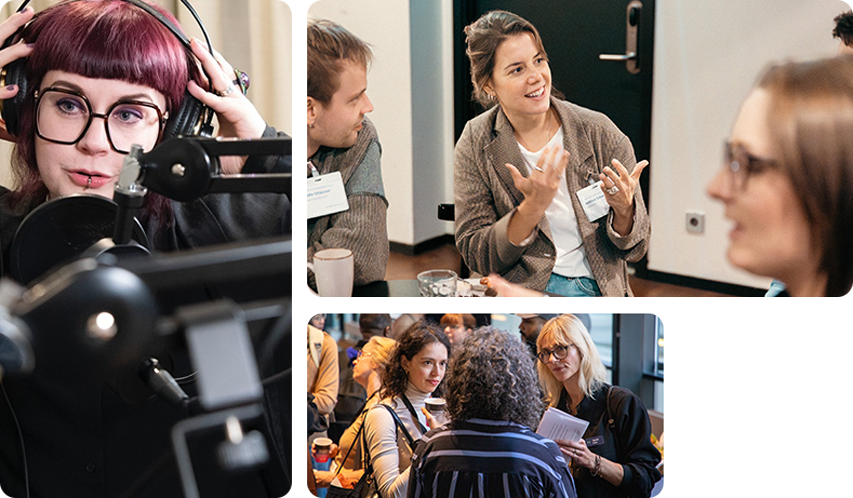
The Knowledge Foundation’s Jubilee Doctoral Students is an investment in the next generation of collaborative researchers. The initiative will now be studied in the five-year research project FöljSAM, led by Sofia Lundmark, associate professor of media technology at Södertörn University.
"
This has never been done before. The initiative brings together doctoral students and supervisors from such a wide range of universities and disciplines, all with the ambition of strengthening collaboration. It gives us a unique opportunity to gain insights into things we haven’t been able to see before.
Sofia Lundmark
Associate professor of media technology at Södertörn University
What makes collaboration work?
The Jubilee Doctoral Students initiative aims to prepare researchers to work both within and beyond academia, with the ability to collaborate across organisational boundaries. But how those skills actually develop during doctoral education remains largely unexplored.
“Collaborative competence involves conducting research into societally relevant issues in ways that make it relevant not only to the research community, but to a wider range of stakeholders. It’s about being able to collaborate with others as part of your research”, says Sofia.
Through FöljSAM, the researchers will examine how doctoral students, supervisors and collaboration partners interact, and what supports or hinders the development of collaboration skills. They will also explore how these conditions vary across research fields and different collaboration settings.
“I hope the findings can provide tools for promoting collaboration across different research fields, as well as insights into how to supervise collaborative research”, says Sofia.
The project will also provide the Knowledge Foundation with valuable insights.
"
We saw a unique opportunity to maximise the value of our major investment in the Jubilee Doctoral Students. For us, this is a chance to learn from the initiative as it unfolds and apply that knowledge when developing future initiatives.
Signild Kvart
Programme manager at the Knowledge Foundation
Bridging disciplinary boundaries
A central part of the Jubilee Doctoral Students initiative is the network that brings together all the doctoral students and their supervisors. The researchers will also examine the role of this network as part of FöljSAM.
“Jubilee doctoral students from a wide range of research fields come together regularly at our network meetings. It will be very interesting to see what role these interactions across disciplinary boundaries play in the insights that emerge from the research”, says Signild.
The research team behind FöljSAM is also interdisciplinary. It brings together six researchers from four universities, with expertise spanning learning and organisational change, design, innovation, production systems, management, governance and business administration.
“One of the project’s strengths is the diversity of backgrounds, experiences and organisational contexts, both within the research team and among the doctoral students, supervisors and collaborative partners involved in the jubilee initiative. I believe this diversity will help us uncover things we might otherwise have missed” says Sofia.
FöljSAM at a glance
Total funding: SEK 12.2 million, including SEK 5.6 million in funding from the Knowledge Foundation.
Project period: Five years, 2026–2031
Participating universities: Södertörn University (Sofia Lundmark and Malin Gawell), Mälardalen University (Linda Höglund and Karin Axelsson), Jönköping University (Kristina Säfsten) and Halmstad University (Eugenia Perez Vico).
