New call for co-funding within MSCA COFUND
This autumn, the Knowledge Foundation will launch a new call offering co-funding for doctoral progra...
Read more



Autumn calls 2026
– key dates
This autumn, the Knowledge Foundation will launch a new call offering co-funding for doctoral progra...
Read more

Five early‑career researchers are now being given the opportunity to further develop their academic ...
Read more


What Does Co-Production Mean?
Co-production forms the basis of Knowledge Foundation’s operation and is an inherent element in the projects, the research and the educational environments that we fund. Co-production means that the projects we fund must be designed and implemented in close collaboration between academia and the business sector.
Why co-produce?
Co-production gives researchers and business actors an insight into and an understanding of each other’s needs. This also provides better conditions for research to be implemented and contribute to innovation, development, and renewal.
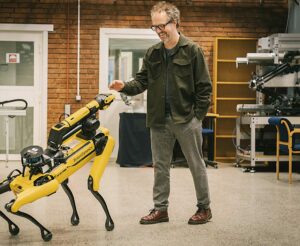
Johan Eker is the adjunct professor who became a “real” professor in an environment based on close c...
Read more

Emma Björkenstam practises what she preaches. As an area manager at ByggDialog, her work involves en...
Read more
Co-funding for doctoral programmes awarded under the MSCA (Marie Skłodowska-Curie Actions) COFUND action.
Application deadline
Development or further development of second cycle study programmes that are business-relevant.
Application deadline
Strategic recruitments of early-career researchers.
Application deadline
Research project for an early career researcher who in collaboration with business partners addresses a scientific question.
Application deadline
Research project for researchers who in collaboration with business partners addressess a scientific question.
Application deadline
Implementation of several research projects where researchers in collaboration with business partners addressess an integrating research question.
Application deadline
Strategic recruitments of international guest researchers or appointmens of adjunct professors or senior lecturers.
Application deadline
Long-term research initiatives that strengthen the national and international position of research environments.
Application deadline
Development and implementation of doctoral education in collaboration with the business sector.
Application deadline
Development and implementation of business-relevant educational activities at second cycle level for working professionals.
Application deadline
Co-funding for doctoral programmes awarded under the MSCA (Marie Skłodowska-Curie Actions) COFUND action.
Application deadline
Development or further development of second cycle study programmes that are business-relevant.
Application deadline
Strategic recruitments of early-career researchers.
Application deadline
Research project for an early career researcher who in collaboration with business partners addresses a scientific question.
Application deadline
Research project for researchers who in collaboration with business partners addressess a scientific question.
Application deadline
Implementation of several research projects where researchers in collaboration with business partners addressess an integrating research question.
Application deadline
Strategic recruitments of international guest researchers or appointmens of adjunct professors or senior lecturers.
Application deadline
Long-term research initiatives that strengthen the national and international position of research environments.
Application deadline
Development and implementation of doctoral education in collaboration with the business sector.
Application deadline
Development and implementation of business-relevant educational activities at second cycle level for working professionals.
Application deadline
All Programmes Contribute
Our programmes are aimed at enabling environments to establish and maintain a strong, long-term, national and international scientific or artistic position which also contributes to the profiling of the higher education institution. This enables the environment to also become a valuable long-term partner for the business sector.
What Is a Strong Environment?
A strong environment is one that has the capacity to develop its research and education in collaboration with the business sector, and takes a long-term, strategic approach to its development. Prioritisation and a shared, embedded ambition are crucial to establishing a strong scientific position and profile with high business sector and societal relevance.

Since our establishment in 1994, the Knowledge Foundation has distributed over SEK 12.9 billion for research and competence development.

In 2025, a total of 323 projects were ongoing with funding from the Knowledge Foundation.

In the projects that were granted funding by the Knowledge Foundation in 2025, a total of 185 business actors were involved as co-financers.